
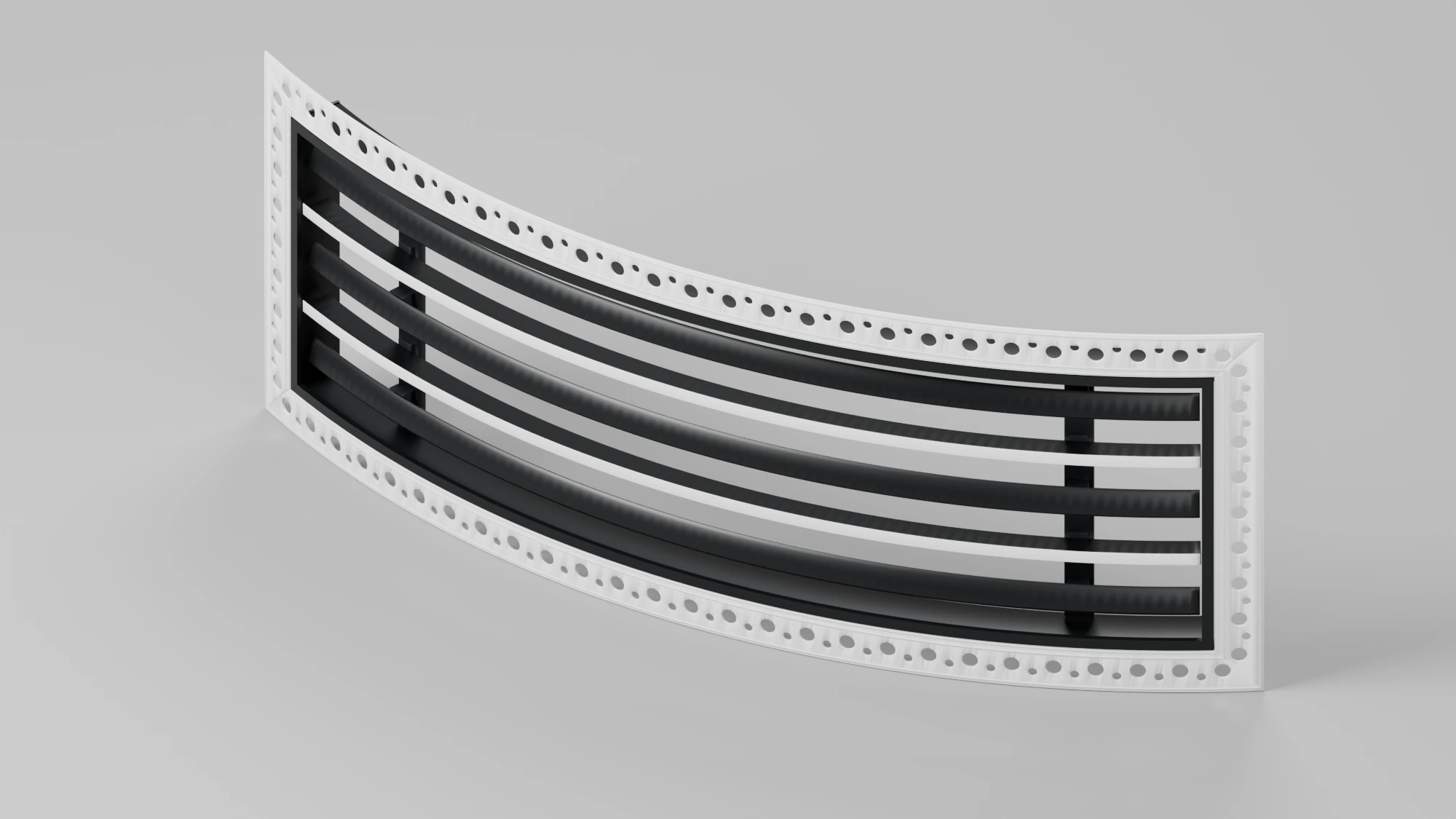
Reviewed 13 October 2026. In a heritage or refurbishment project, start with the existing ceiling and service routes. A standard linear slot diffuser may be suitable, but its dimensions, connection and visible frame need to be checked against the surveyed building.
Custom fabrication can resolve geometric constraints. It does not remove the need to confirm airflow performance, access and the proposed effect on the building fabric.
1. Survey the space above the ceiling
Record the shallowest usable depth along the proposed run, the position of joists or other obstructions, and the space needed for duct connections, supports and maintenance. Distinguish the grille or diffuser body depth from the depth of the complete connected assembly.
Do not assume a shallower terminal will retain the performance of a different tested configuration. Ask the MEP designer to confirm the required air volume and the evidence needed for air distribution, pressure loss and noise at the proposed installation.
2. Match the run to the opening
Measure the opening at its ends and intermediate points, noting any taper or curvature. Show the intended finished line, corner angles, end conditions and how sections will join. Long runs may need multiple sections; agree their lengths and joint positions before production.
Confirm tolerances and installation allowances on the drawing. A nominal length alone does not define the fit, and cutting a finished unit on site should not be assumed to preserve its assembly or performance.
3. Coordinate the visible frame and finish
Review the frame width, reveal, colour and adjoining plaster or joinery together. Choose the detail around the fixing, finish and maintenance requirements. A narrow frame or plaster-in edge is an option to evaluate, rather than a universal answer.
For protected fabric, the project team should agree the intervention before work starts. Historic England’s guidance on installing new services emphasises careful survey, reducing damage to historic fabric and planning accessible service routes. It is guidance for England; requirements elsewhere should be checked with the relevant local project team.
A useful brief for a custom quotation
- Surveyed opening dimensions, ceiling section and available depth.
- Straight lengths, curves, corner angles and proposed section joints.
- Supply or return function, air volume and performance requirements from the MEP designer.
- Frame detail, material, finish reference and any sample requirement.
- Maintenance access, quantity, destination and target installation date.
Confirm price and delivery for the actual order
Hongyang makes custom diffusers and grilles in our Zhenjiang workshop. Linear products normally start at 20 metres per order. Small batches normally dispatch within a week, with material availability, finish and order details confirmed at quotation. Long runs are supplied in agreed sections.
Sample pricing and any order-related discount are agreed in the quote. Transport time and delivery terms depend on the forwarder and destination. We confirm these for the enquiry rather than promise a fixed shipping duration or a standard delivered price.
Send your project brief · mike@hongyanghvac.net · See installation details
Related guide: Specifying plaster-in diffusers: ceiling details to confirm.